
The Passwordless Paradox in Hospitals
 For the modern health system, the mandate to "go passwordless" is no longer a matter of debate. Passwords are, by every measurable metric, a failure: they are the leading vector for credential-based attacks, a constant drain on help-desk resources, and universally loathed by the people forced to remember them. Across industries, the case is clear: passwords are a liability, not a solution.
The goal is clear: eliminate passwords entirely.
But in hospitals, achieving passwordless authentication is anything but straightforward. Unlike corporate offices, hospitals operate as two distinct environments under one roof: the enterprise environment and the clinical environment. The friction between these two worlds is where most passwordless initiatives stall, or, in some cases, die entirely.
The Same Building, But Worlds Apart
The enterprise side of hospitals — finance, HR, and executive offices — operates in predictable, single-user environments. Devices are assigned, workflows are structured, and IT can centrally manage enrollments. In these areas, standard passwordless solutions such as platform-native solutions like Windows Hello, FIDO2/Passkeys, or phone-based MFA generally function as intended. Deployment is straightforward, adoption is quick, and scaling is largely predictable.
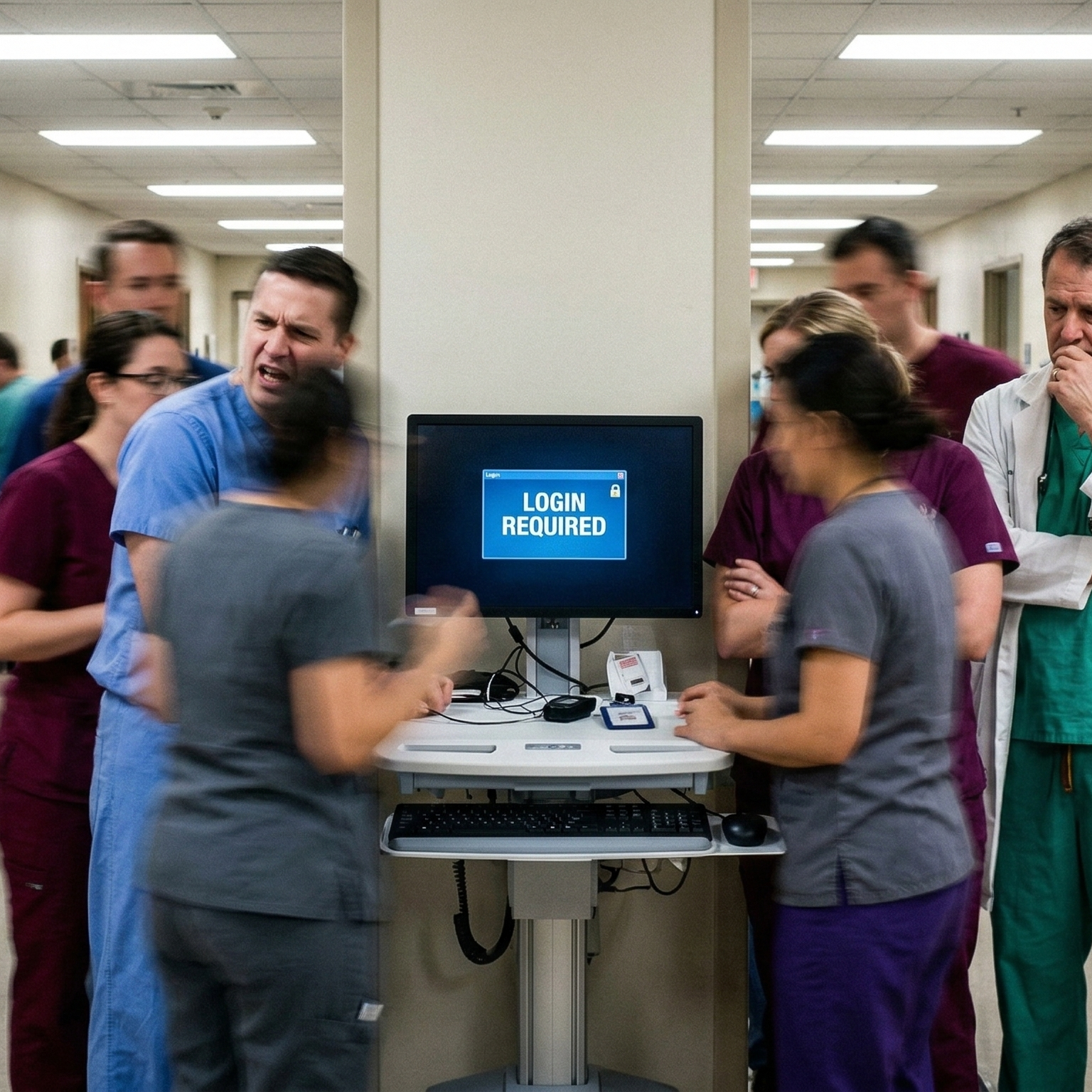
The clinical environment, however, is a completely different story. Shared workstations are the norm, with dozens of clinicians using a single terminal over the course of a shift. Mobile access is restricted in sterile or high-acuity zones, and PPE interferes with biometric logins. Clinicians rotate between patient rooms, operating rooms, and different units dozens of times a day. Traditional passwordless solutions, designed for office workflows, collide with these clinical realities. The result is login friction that slows care delivery, frustrates clinicians, and ultimately leads to passwordless projects being deprioritized or abandoned entirely.

Why Traditional Passwordless Breaks Downs on the Clinical Floor
On the hospital floor, workflows are fast, shared, and unpredictable. Clinicians constantly rotate between patient rooms, units, and shared workstations, often in environments where mobile devices are restricted, and PPE interferes with biometric logins. Solutions built for a single user per device collide with these realities, creating friction that slows care and frustrates staff.
Three core challenges define the problem:
Shared Workstations: A single terminal may be used by dozens of clinicians each shift. Traditional passwordless tools, which rely on per-device enrollment, create an operational burden that quickly scales across hundreds of devices and units. Nurses and physicians running between critical tasks can be blocked by login prompts on machines they haven’t registered.
Mobile Restrictions: Many passwordless flows assume clinicians have access to a phone for push notifications and biometric approval. In sterile or high-acuity areas, phones are prohibited, and PPE makes biometrics impractical. Even when phones are allowed, retrieving and unlocking a device interrupts workflows and slows care.
Biometric Limitations: Face or fingerprint recognition may seem ideal, but masks, gloves, and protective equipment interfere. Privacy and regulatory concerns limit camera deployment in patient areas, and lighting or environmental conditions can make sensors unreliable.
Combined, these factors create a patchwork authentication experience. Each login interruption may seem small, but over the course of a shift, they add up, resulting in frustrated staff, increased cognitive load, and reduced adoption of passwordless initiatives.
What Sets Twosense Apart
Twosense addresses this challenge by rethinking authentication entirely. Instead of verifying identity only at login, Twosense continuously validates the user behind the session. Typing cadence, keystroke rhythm, and mouse movement are used to create a behavioral profile unique to each clinician. Identity verification becomes ongoing, invisible, and impossible to replicate or share.
This approach solves the barriers that have traditionally blocked hospital passwordless adoption:
- Identity follows the user: Clinicians are recognized across any workstation without device-specific enrollment.
- Silent, continuous verification: Phones, tokens, or repeated prompts are unnecessary; authentication occurs in the background.
- PPE and privacy neutral: Masks, gloves, and gowns do not interfere, and no cameras or invasive monitoring are required.
- Unified experience: Authentication works consistently across enterprise and clinical systems, eliminating “hoop-jumping.”
Hospitals deploying Twosense see immediate benefits. Help-desk tickets drop as password resets vanish, login failures decline, and access to patient systems becomes faster and more reliable. Continuous Authentication strengthens security while remaining invisible, bridging the gap between enterprise standards and clinical realities.
The 3–60–90 Path to Passwordless
-3.png?width=3900&height=659&name=90%20Days%20to%20Passwordless%20for%20Hospitals-6%20(1)-3.png)
A common misconception is that passwordless adoption requires years of planning and a full-scale identity overhaul. Twosense proves that it can be done quickly with a focused, phased approach. The 3–60–90 model is a tested framework designed to deliver tangible results while minimizing operational friction:
3 Applications: Start with three high-touch, high-priority applications, typically those clinicians use most frequently or that are most critical to patient care. Keeping the initial scope small ensures deployment is manageable while delivering immediate value.
60 Users: These three applications are rolled out to a cohort of roughly 60 users. This allows IT to validate workflows, mature behavioral profiles, and ensure the platform works seamlessly on shared workstations and in mobile-restricted environments. Early operational insights, such as help-desk tickets, login failures, and clinician feedback, help inform optimization.
90 Days to Passwordless: Within 90 days, the initial deployment cohort achieves full passwordless access across the selected applications. Clinicians experience seamless logins without interrupting workflows, IT sees reduced support burden, and security teams gain confidence in continuous verification.
Once this foundation is in place, hospitals can begin scaling. Additional applications and users are gradually added, eventually achieving enterprise-wide passwordless access. The beauty of this approach is that scaling happens without operational friction or workflow disruption—clinicians never have to re-enroll, and IT does not have to restructure identity systems.
Scaling Passwordless Across the Enterprise
Achieving passwordless access is a milestone; scaling is where many initiatives fail. Hospitals manage tens of thousands of users, hundreds of applications, and millions of authentication events annually. Solutions that require repeated device enrollment, rely on mobile prompts, or depend on physical biometrics quickly hit operational limits.
Twosense’s Continuous Authentication platform is designed to scale from day one. Identity follows the user across all devices and environments, and authentication runs invisibly in the background. Security is strengthened because each session is continuously verified, and anomalous behavior triggers automated remediation without disrupting care. Integration with existing identity systems means hospitals don’t need to rebuild infrastructure to achieve enterprise-wide passwordless access.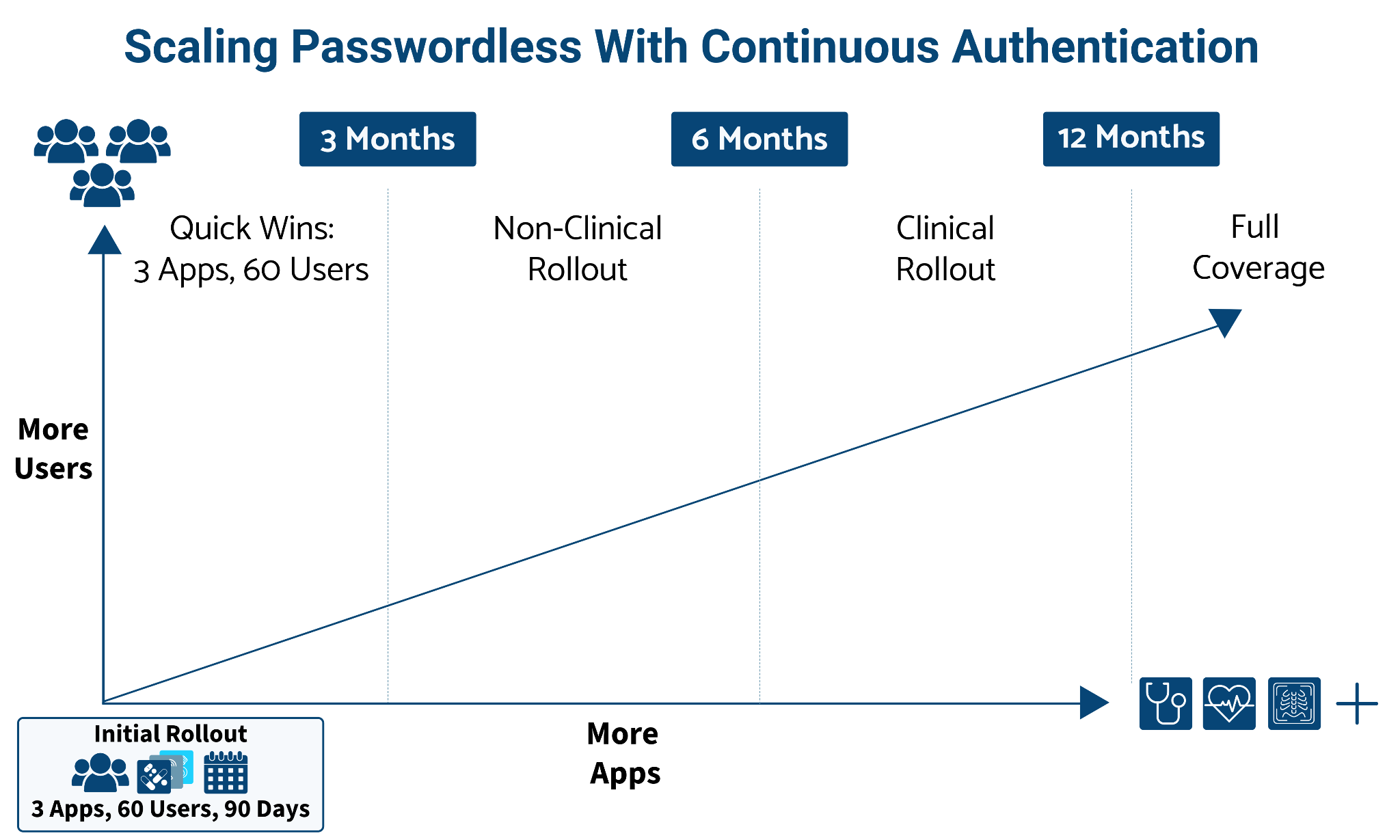
The operational impact is immediate and measurable:
- Failed logins drop by over 89%
- Password-related help-desk tickets decline by nearly 79%
- Clinicians gain uninterrupted access to critical systems
- Security teams get real-time visibility into user activity and policy enforcement
Scaling passwordless without friction also improves clinician satisfaction and adoption. Doctors, nurses, and technicians spend less time navigating authentication barriers and more time on patient care. IT teams can deploy new applications without worrying about login friction. Hospital leadership achieves both regulatory compliance and enterprise security while supporting clinician efficiency.
Passwordless Made Easy
Going passwordless in hospitals does not require a complete identity overhaul with the right solution. Twosense combines continuous behavioral authentication with a 3–60–90 rollout framework to deliver passwordless access in as little as 90 days. Clinicians experience seamless login across shared workstations, mobile-restricted environments, and high-acuity workflows. IT sees fewer help-desk tickets and less operational friction, while security teams gain continuous access evaluation of every session.
From the initial deployment of three applications and 60 users to enterprise-wide adoption, hospitals can scale passwordless authentication without compromising workflows, disrupting care, or overhauling infrastructure. Passwordless is not a theoretical goal; it’s achievable, scalable, and sustainable.
Twosense bridges the gap between enterprise security needs and clinical realities, delivering a uniform authentication experience that protects sensitive data while enabling clinicians to focus on what matters most: patient care.
Schedule a demo today to see how your hospital can achieve passwordless in 90 days and begin scaling without interruptions or friction.
.png)
.jpeg)