


The Tradeoff Everyone Assumes
Security and productivity get treated as opposite ends of the same lever in most health systems identity conversations: tighten one, and the other gives. Add a step-up prompt, and clinicians lose time. Shorten a timeout, and staff spend more of their shift logging back in. That tradeoff is real for the tools most health systems have relied on so far, because those tools only have one way to increase assurance: ask the user to prove their identity again.
What Actually Happens When Both Improve Together
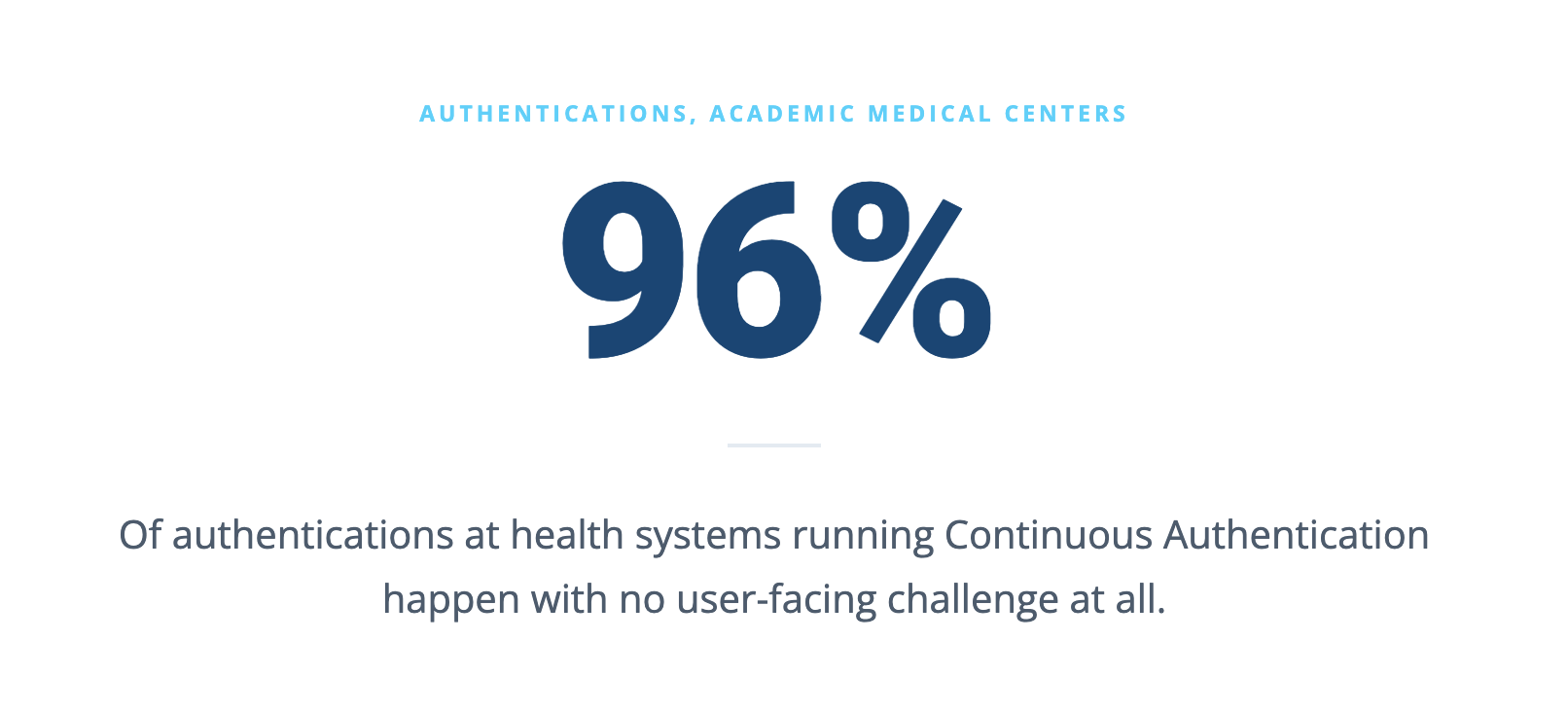
Continuous Authentication breaks that tradeoff because it increases assurance without asking the user to do anything differently. At academic medical centers already running it, 96% of authentications happen with no user-facing challenge at all, the system confirms identity from behavioral signals in the background while the clinician keeps working. Help-desk tickets tied to authentication and identity issues drop by 89%. Failed logins drop by 79%. Health systems recover an estimated 95% of the time previously lost to authentication friction, the same hours quantified in the previous piece in this series.
Why That's Different From a Cost Argument or a Security Argument
Those numbers describe the same session getting more secure and less disruptive at the same time, which is the part of the story a pure cost argument or a pure security argument each miss on their own. A cost argument alone risks sounding like security is a line item to be minimized. A security argument alone risks sounding like clinicians should expect more friction as the price of protection. Neither framing matches what actually happens when identity assurance shifts from a single login event to a continuous, passive signal: the friction goes down because the system stops needing to interrupt anyone to stay confident, and confidence goes up because it's no longer based on a decision made once, hours ago.
The Question for Health System Executives
For a health system executive weighing whether stronger identity assurance is worth the operational cost, the more accurate framing isn't "how much productivity are we willing to trade for security." It's that the tradeoff itself is an artifact of point-in-time authentication, and it mostly disappears once identity assurance stops depending on interrupting the user to get it. That's the outcome a continuous identity strategy is supposed to produce, and it only shows up when the signal behind it is strong enough to run without asking the user for help.