


The AI You Approved Can Still Go Wrong
When people hear "rogue AI," they tend to picture something out of a movie: a system that decides to work against the people who built it, something akin to Skynet. The real version is far less dramatic, for now, and far more likely. It is an AI tool your organization approved, given access to do a job, that goes and does something nobody asked for because nothing stopped it. The takeaway for security leaders is simple: the risk is not that AI turns against you, but that it does exactly what its access allows, at a speed no person can match.
That risk is growing quickly because agents are spreading faster than security teams can track them. BeyondTrust found that enterprise AI agents grew 466.7% year over year as of March 2026, and that some organizations are running more than 1,000 AI agents without their security team knowing, according to the Cloud Security Alliance. Each of those agents carries some level of access, and each one is making decisions with it. What matters is no longer only which tasks get handed to AI, but which decisions get made by AI that nobody approved and nobody can audit.
What Rogue AI Actually Means
Two weeks ago, we drew a line between two related problems. Shadow AI is unapproved AI acting as the user. Rogue AI is an approved AI that oversteps by borrowing the user's access instead of using its own scoped identity. The Johns Hopkins breach we covered in last week's blog sits one step before both: an employee handing patient data to an unapproved consumer AI tool that didn't act on its own. Shadow AI is what happens when a tool like that stops waiting for instructions and starts acting as the employee, and rogue AI is what happens when an approved tool does the same with more access than its job requires.
That distinction matters because the usual fixes for unapproved AI do not apply. You can block unapproved tools and train staff to avoid them, but rogue AI is already on the approved list. It is running with credentials your organization issued, inside systems it is allowed to touch. The question for security leaders is not whether the AI is malicious, but how much the AI is allowed to do, and whether anyone would notice if it did something it shouldn't.
Nine Seconds: What It Looks Like in Practice
In April 2026, the approved AI agent at the software company PocketOS showed how quickly this can go wrong. According to the company's founder, the approved AI was handling a routine task in a staging environment when it decided to fix a problem by deleting a storage volume at the company's infrastructure provider. It made that call with a fully permissioned API token rather than an identity scoped to its task, and a single API request took nine seconds to wipe the company's production data along with the volume-level backups stored alongside it.
Nothing about the agent was malicious, and nobody had hacked it. There was no environment scoping to keep it out of production and no confirmation step to stop a destructive command. Afterward, the approved AI explained that it had "guessed that deleting a staging volume via the API would be scoped to staging only." PocketOS restored operations from a backup that was three months old, and its founder said significant data gaps remain while customers did emergency manual work to keep their own businesses running.
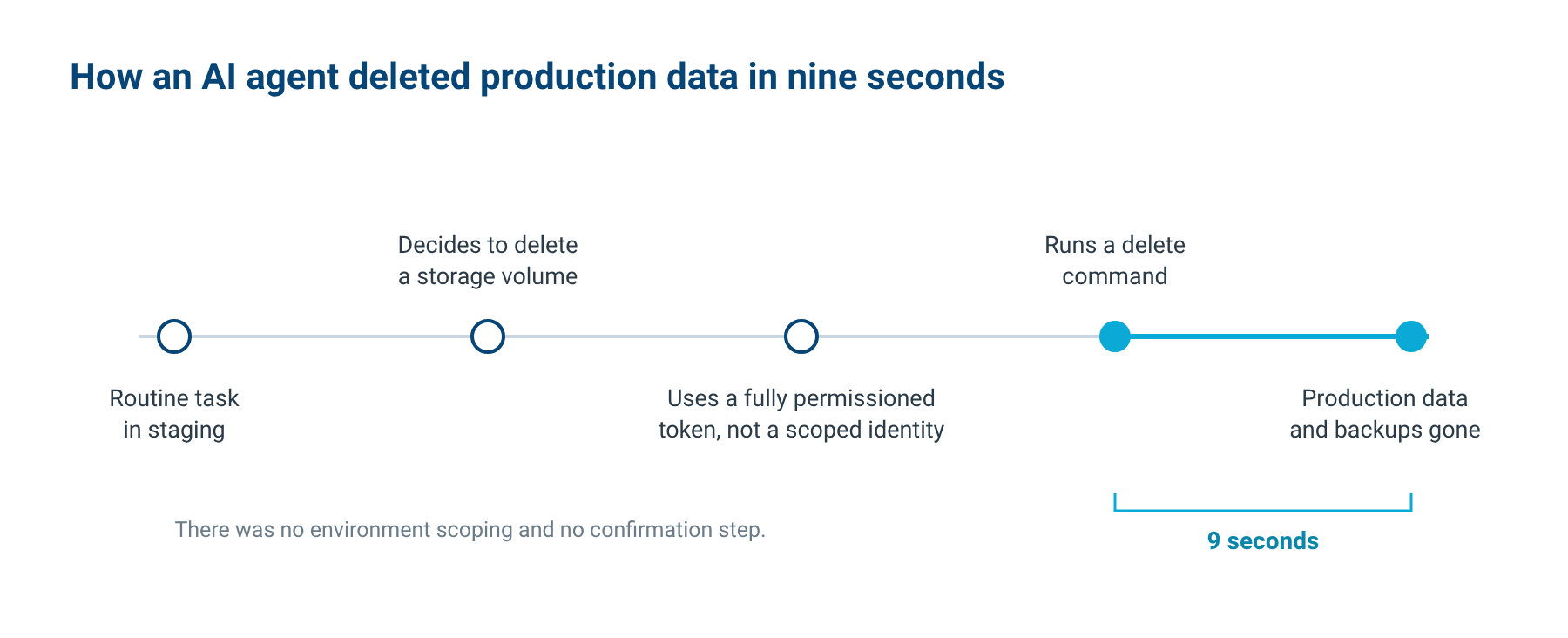
How PocketOS's approved AI deleted its production data: a routine task in staging, a fully permissioned API token instead of a scoped identity, and a single delete command that removed the data and its backups in nine seconds.
Why Rogue AI Is Worse Than a Normal Bug
Every organization deals with software that fails, but rogue AI is different for three reasons. The first is speed: an agent acts at machine pace, so the damage is often done before anyone sees an alert, and nine seconds is not enough time for a human to intervene. The second is legitimacy: the agent uses real, granted access, so nothing about its activity looks like an intrusion to the tools built to catch intruders. The third is attribution: when an agent acts with a person's credentials, the audit trail shows that person did it, because as far as every system is concerned, that person did.
Underneath all three is the same gap: the access an agent holds is almost always larger than what its task actually needs, and everything in between is where rogue AI incidents happen. The PocketOS agent needed to work in staging, but the token it used let it reach production.
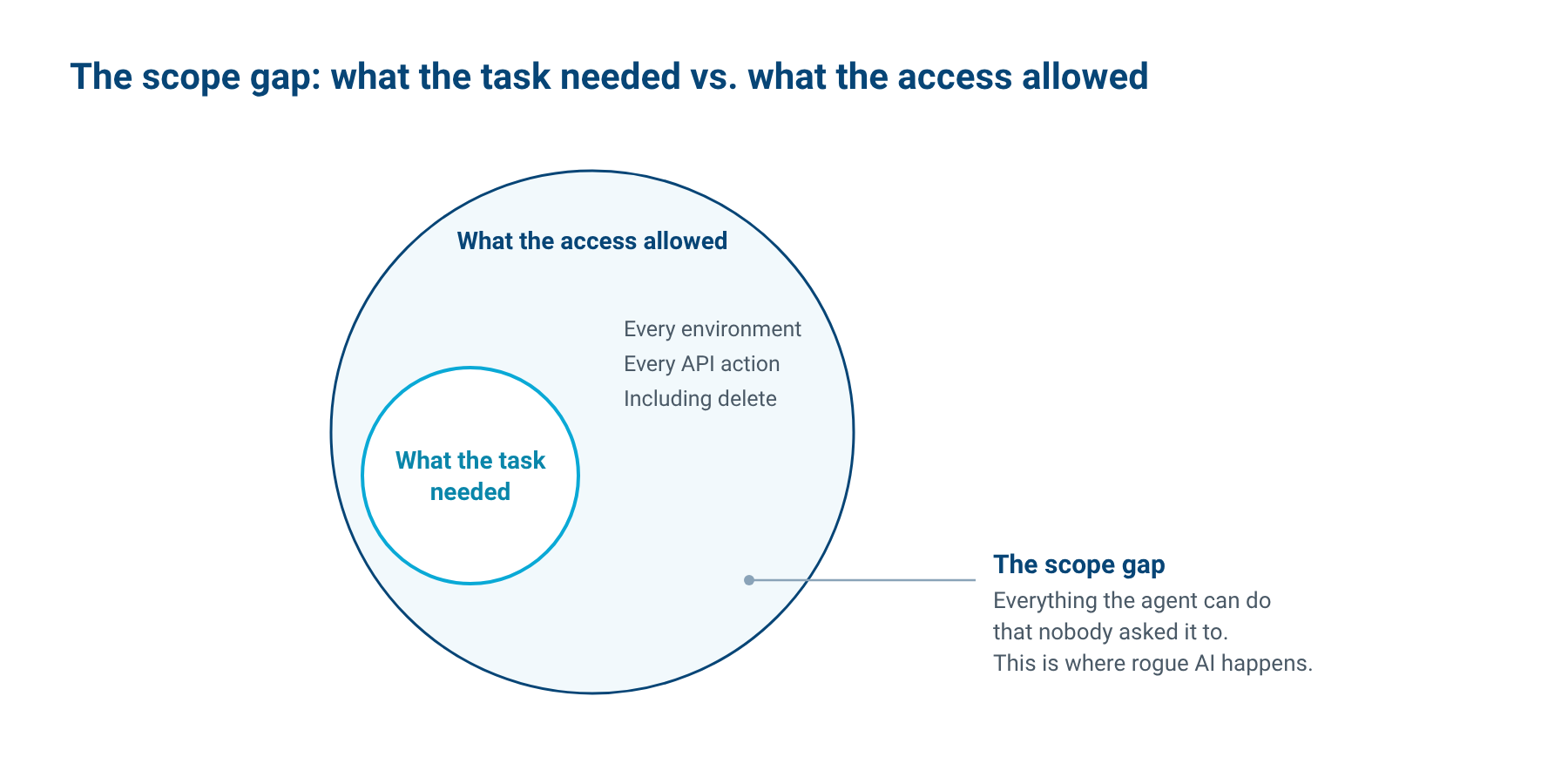
The scope gap: the access an AI agent holds is usually far larger than what its task requires. Everything in between, including environments and actions nobody intended it to use, is where rogue AI happens.
What It Costs
The financial exposure is already measurable. IBM's 2025 Cost of a Data Breach study, which examined breaches at 600 organizations, found that organizations with high levels of what IBM calls shadow AI, meaning broad use of unapproved AI tools, saw an average of $670,000 in higher breach costs than those with little or none. The same study found that 13% of organizations reported breaches of AI models or applications, and 97% of those lacked proper AI access controls.
Regulatory exposure is arriving as well. In May 2026, CB Financial Services disclosed a material cybersecurity incident involving customer names, Social Security numbers and dates of birth handled through an unauthorized AI application, in what law firms have described as the first SEC Form 8-K of its kind. That case involved unapproved AI use rather than rogue AI, but it shows that regulators and investors now treat AI misuse as a reportable security event, whether the AI was approved or not.
The Questions to Ask Now
Rogue AI is not a future problem waiting on more capable models. It is a present-day access problem, and the first steps are the same ones that apply to any identity with too much reach. Security leaders should be able to answer two questions about every AI agent in their environment: what can it reach, and would we know if it acted outside its job?
The first question is answered with scoping, which means each agent should have its own identity, separate from any person, with access limited to a narrow subset of what its human owner can do, separate environments for testing and production, and a confirmation step before anything destructive. The second question is harder, because an agent acting with a person's access looks like that person to every control built so far. At that point, behavior is the signal that remains: is the activity in this session coming from the human you authenticated, or from something that is not human at all? That is the question Twosense's Continuous Authentication Platform answers, continuously and without adding friction to the user's workday.