


A Fair Amount of Skepticism Is Warranted
Health Systems security teams have earned the right to be skeptical of anything that sounds like a new acronym for an old idea. So it's worth being precise about what Continuous Authentication actually is, because it isn't a stronger version of MFA, and it isn't trying to replace it.
Two Different Questions
MFA answers a specific question at a specific moment: can this person prove they are who they claim to be, right now, using something they know, have, or are? It's an excellent answer to that question, and health systems should keep asking it at login. What MFA was never built to answer is a second question that only matters after authentication succeeds: does the person using this session still match the identity that logged in ten minutes ago, or an hour ago, or after a shift handoff most of this series has already walked through in detail?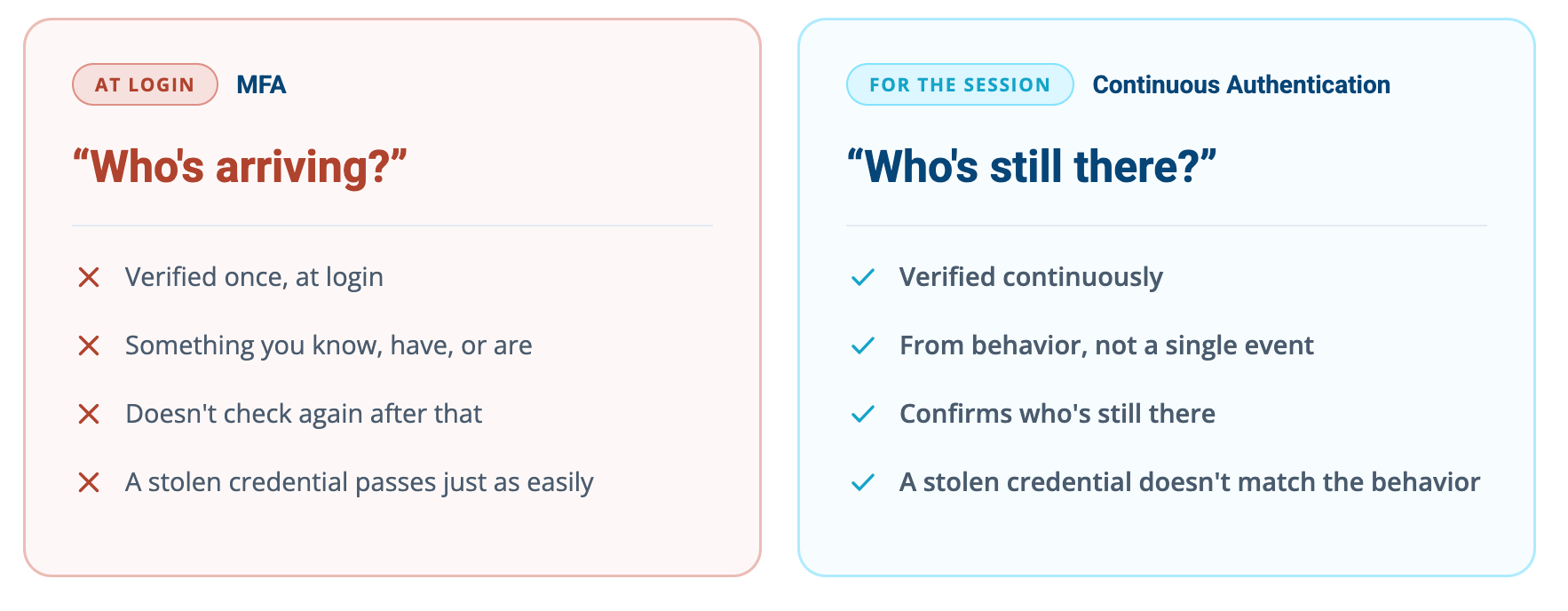
What Continuous Authentication Actually Detects
That second question is what Continuous Authentication is for. Instead of a single decision made at the login screen, it evaluates behavioral signals, things like typing rhythm and interaction patterns, continuously while the session is active. When the behavior stops matching the authenticated user closely enough, the system has detected what Twosense refers to as a behavioral mismatch, evidence that the person operating the session may no longer be the person who logged in. That's a different kind of evidence than anything MFA produces, because MFA only ever has one data point: the moment of login.
Why the Two Controls Fail Differently
The distinction matters because the two controls fail differently. MFA can be defeated by a stolen or shared credential presented once, at the door. Continuous Authentication doesn't care how the session started, it's watching what happens inside it. A shared credential or an abandoned session that MFA would have no way to flag becomes visible the moment the behavior inside the session no longer matches the identity it's associated with.
Both, Not Instead Of
None of this argues that MFA should get weaker or go away. Strong authentication at login remains necessary, it's just not sufficient on its own for the length of a session. The two controls sit at different points in the identity lifecycle: MFA establishes who's arriving, Continuous Authentication confirms who's still there. Put together with the systems that carry and act on that signal, this is what a continuous identity architecture actually requires, not a stronger login alone, and not a policy engine with nothing but device and network data feeding it.