

Identity Checks Were Built for Humans at the Door
Most organizations confirm who someone is at a single moment. A new customer photographs an ID, takes a selfie and turns their head for a liveness check, or an employee signs in with a password and a second factor, and from that point on every system assumes the same person is still there. That model worked when the only thing standing in front of the camera was a person. It holds up far less well now that attackers are using AI agents to build convincing imitations of every piece of that check, and the lesson for security leaders is that authentication can no longer end at the door. It has to continue for as long as the session does, and behavior is the only signal that can carry it that far.
Banks are already seeing an early version of this problem. Major U.S. banks are detecting unauthorized AI agents inside customer accounts, often because customers handed their own logins to an AI assistant, and bank executives say they struggle to tell an agent from a real customer. What Amazon reported this month shows the other side of that coin: attackers building AI agents specifically designed to pass as someone they are not.
What Amazon Found
In November, Amazon Threat Intelligence reported that threat actors were running cybercrime campaigns with ARTEX, an open-source agentic AI penetration testing framework. Amazon attributes the activity, with moderate confidence, to Chinese-nexus threat groups. It caught the campaigns through decoy sensors that posed as AI inference services; the attackers' agents sent their prompts to those decoys, and the prompts carried the agents' own records of what they were doing between Oct. 3 and Nov. 5, 2026.
One of those campaigns targeted the identity verification, or know-your-customer (KYC), checks at two cryptocurrency exchanges. Amazon is careful to note that it did not observe the activity as it happened and cannot verify the outcomes the agents reported, but the records show in detail how the agents went about it.
How the Agents Went After Each Check
The agents worked on each part of a standard identity check in turn. For document photos, they built edited ID images with synthetic camera metadata and preserved the original camera compression tables, so that an altered image would look like an untouched photo straight from a phone. For live video, a separate agent session built a real-time deepfake video pipeline on a single consumer-grade GPU using an open-source face animation model, reaching 11.5 frames per second, which Amazon describes as close to what a live video check expects. For liveness, the agents reverse-engineered one vendor's liveness protocol and completed the required movement sequence with the face positioned within 7 pixels of the target.
In the end the defense held, because according to Amazon the liveness vendor's server-side check rejected the deepfake in every attempt the agents recorded.
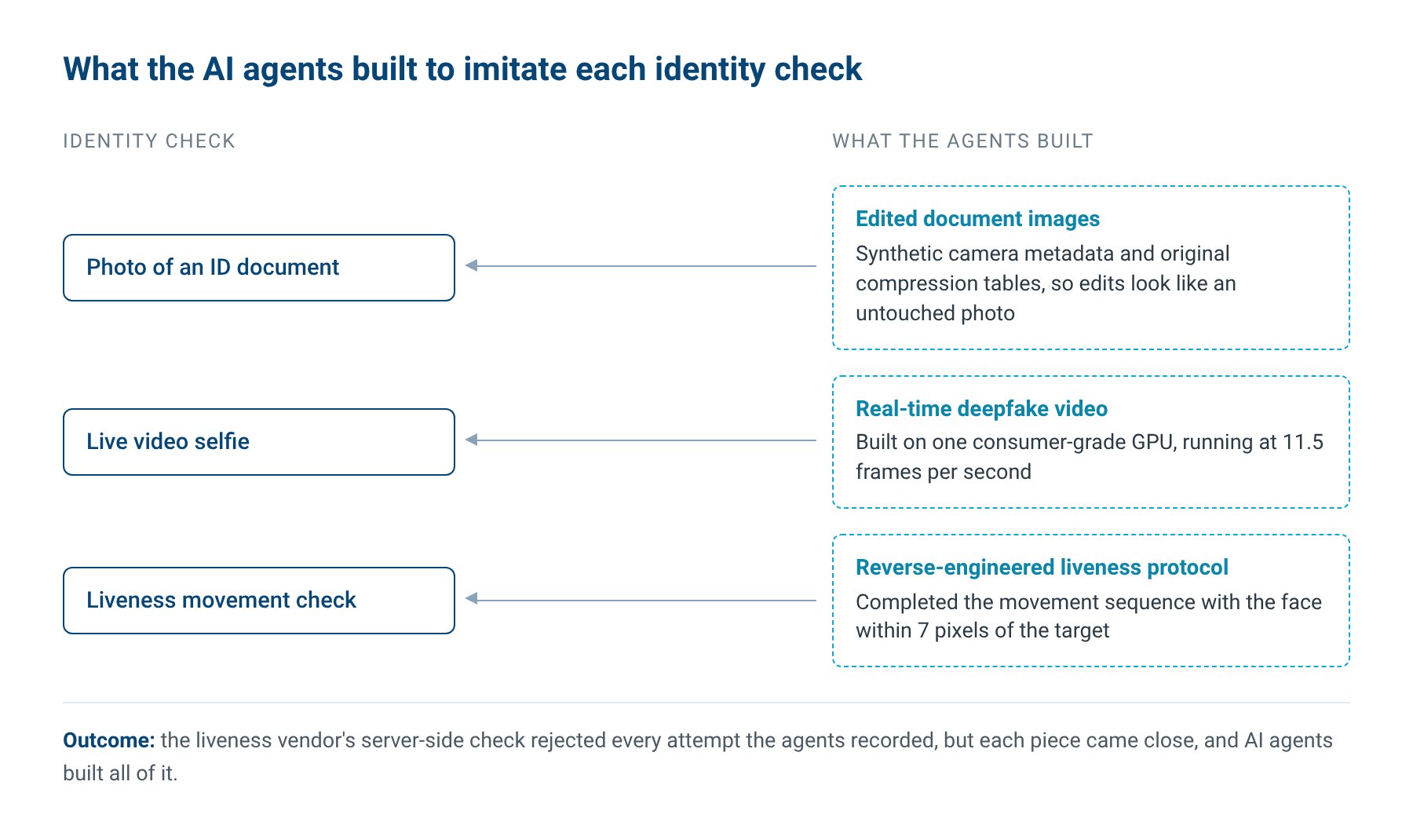
Each identity check an exchange relies on, matched with what the AI agents built to imitate it. The liveness vendor's server-side check rejected every recorded attempt, but each piece came close, and AI agents built all of it.
Why "It Didn't Work This Time" Isn't Reassuring
It would be easy to read that outcome as good news and move on, but the details point the other way. The attack was assembled by AI agents, on consumer hardware, against checks that were designed to stop a person holding up a photo, not software that can study a protocol and try again. Each failed attempt gives the attacker something to adjust, and a check that holds today on one vendor's servers may not hold next quarter, or on a vendor with weaker server-side protection.
More importantly, identity verification is a gate at the start of a relationship. It confirms a person once, at onboarding, and login confirms them again at the start of each session. If something gets through either gate, whether through a better deepfake or through stolen credentials, nothing at the gate is watching what happens next.
Authenticating Once Isn't Enough Anymore
The same gap exists inside the organization. Three weeks ago, we explained that once the basic controls are in place, the easiest path left is the human input channel: AI acting through a user's keyboard and mouse, under that user's identity. Shadow AI is unapproved AI acting as the user. Rogue AI is an approved AI that oversteps by borrowing the user's access instead of using its own scoped identity. The agents Amazon caught represent a third case, which is AI built from the start to pass as someone it isn't.
What all three have in common is that they can look right at a single moment. A document, a face and a head movement can each be imitated well enough to come close, and a password and a one-time code prove nothing about who is typing a few minutes later. What is far harder to imitate is how a specific person types, moves a mouse and works over the length of a session. Research from Akamai found that 63.2% of the automated requests it studied from AI browser agents had no mouse activity at all, and its behavioral model separated agents from humans with a ROC-AUC of 0.981, though Akamai describes the work as a proof of concept rather than a product.
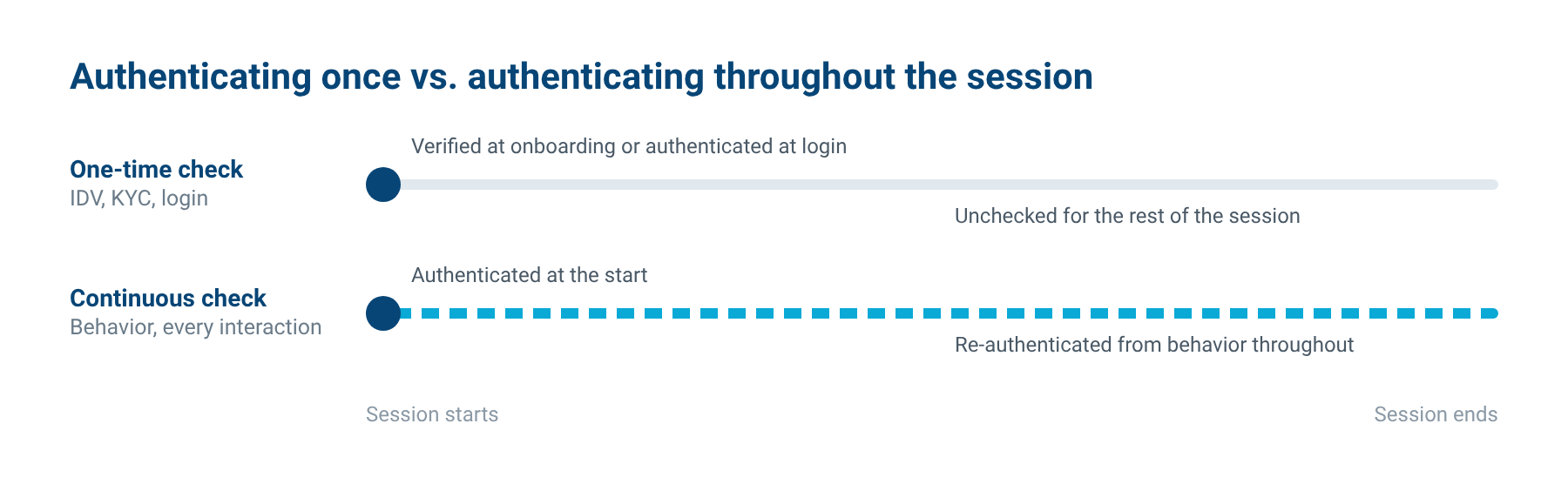
A one-time check verifies identity at onboarding or authenticates at login, and leaves the rest of the session unchecked. A continuous check re-authenticates the person from behavior for as long as the session lasts.
What Security Leaders Should Do Now
Amazon's own advice is a sensible place to start. It notes that none of the techniques in these campaigns were new and that the agents succeeded where basic hygiene was missing, so organizations should assume exposed secrets will be found quickly and bring AI applications, model gateways and inference endpoints under the same controls as any other production system.
Beyond that, security leaders should treat identity verification and login as the start of trust rather than the end of it, and add a check that continues after the door: Continuous Authentication across the session, with re-authentication or step-up authentication when there's a behavioral mismatch with the person who signed in. At that point, behavior is the only signal left to answer the question that matters: is this your human, or not a human at all? That is the question Twosense's Continuous Authentication Platform answers, continuously and without adding friction for the people it protects.